Cool Plant of the Week
As heard on WSB AM750 Lawn & Garden Show
Saturday from 6am-10am
Index-
2002
September October November
December
2003
January February March April
May June July August
September October November December
2004
January February
September 2002
9/21: Helianthus angustifolius 'First Light':
Dwarf Swamp Sunflower
9/28: Sedum 'Frosty Morn'
To top of page
October 2002
10/12: Amsonia hubrectii: Arkansas Blue Star
10/19: Chamaecyparis thyoides 'Heather Bun'
Image only
10/26: Thuja plicata 'Green Giant' - A great native substitute for the Leyland
Cypress
11/2: Hypericum x moserianum 'Tricolor' -
Variegated St. John's Wort -
To top of page
November 2002
Nov. 9 - Taxodium distichum - Bald Cypress
Nov. 16 - Ilex verticillata 'Red Sprite'
(pollinator 'Jim Dandy' or 'Apollo')
This web site has other cultivars listed
and a good list of male pollinators
Nov. 23 - Ulmus alata 'Lace Parasol' - Weeping
Winged Elm
Nov. 30 - Yucca filamentosa 'Color Guard'
To top of page
December 2002
Dec. 7 - Thuja occidentalis 'Emerald Green'
(aka 'Emerald') - Emerald Green Arborvitae
Another image (a scaled down version/substitute for the
Leyland Cypress)
Dec. 14 - Ilex vomitoria 'Pendula' - Weeping
Yaupon Holly
Dec. 21 - Bignonia capreolata - Crossvine
Check out the lower image on this site, where
it has been trained into a tree.
Dec. 28 - Chamaecyparis pisifera 'Gold Mop'
To top of page
January 2003
January 4 - Crataegus viridis 'Winter King'
- Winter King Hawthorn
January 11 - Myrica cerifera (aka Morella
cerifera) - Southern Wax Myrtle
January 18 - Juniperus virginiana 'Burkii'
- Burkii Eastern Red Cedar
Better Image: http://www.esveld.nl/htmldia/j/juvbur.htm
January 25 - Dryopteris marginalis - Marginal
Wood Fern
To top of page
February 2003
February 1- Contorted Filbert (aka Harry
Lauder's Walking Stick) -
Corylus avellana 'Contorta'
February 8- Bright N Tight Carolina Cherry
Laurel - Prunus caroliniana
'Bright N Tight'
(an excellent substitution for Japanese Ligustrum)
February 15- Needle Palm - Rhapidophyllum
hystrix
(Cold Hardy Palm to -10 to -20 degrees!)
February 22- Lenten Rose - Helleborus orientalis
To top of page
March 2003
March 1: Arnold Promise Witchazel (Hamamelis
x intermedia 'Arnold
Promise')
March 8: Winter-blooming Heaths (Erica spp.
and hybirds)
March 15: Autumn Fern (Dryopteris erythrosora)
(The botanical name is misspelled on this
site)
March 22: Saucer Magnolia (Magnolia soulangiana)
(From personal observations, I've noticed
the darker flowering
varieties withstand late frosts better)
March 29: White Redbud (Cercis canadensis
'Alba')
To top of page
April 2003
April 5: Serviceberry: Amelanchier x grandiflora
'Autumn Brilliance'
Note: A good replacement for the Bradford
Pear (flowering at the same
time) and producing edible fruit that is
loved by birds. Available at Craven Pottery
Nursery.
April 12: Red Buckeye: Aesculus pavia
Note: Red flowers attract hummingbirds. Seeds
are not eaten by
wildlife because they are very poisonous.
April 19: Homestead Purple Verbena: Verbena
canadensis 'Homestead
Purple'
Note: Heavy blooming, long flowering, very
fast spreading groundcover
for hot, dry sites and hillsides in full
sun.
April 26: Mapleleaf Viburnum: Viburnum acerifolium
Note: Not always the easiest plant to find,
but worth the search. In
stock at Lazy K Nursery.
To top of page
May 2003
May 3: Foam Flower: Tiarella spp.
Attractive foliage after blooming which remains
evergreen.
May 10: Coral Honeysuckle: Lonicera sempervirens
Well-behaved native honeysuckle with a burst
of flowers in the spring
and sporadic blooming the rest of the season.
Very attractive to
hummingbirds. Comes in red and yellow varieties.
May 17: Virginia Spiderwort: Tradescantia
virginiana
Upright perennial with daylily-type leaves.
Flower colors available:
blue, pink, white, etc.
Tolerates full sun to moderate shade. Shear
plants after flowering to
promote regrowth and blooming
May 24: Coreopsis - Many varieties
A nice group of plants ranging from groundcover
to upright perennial.
Tolerant of hot, dry, sunny locations. Long
bloom season
May 31: 'Pee Wee' Oakleaf Hydrangea: Hydrangea
quercifolia 'Pee Wee'
A nice dwarf variety of the oakleaf hydrangea
To top of page
June 2003
June 7: Bigleaf Magnolia - Magnolia macrophylla
Better Image:
http://www.ashland-city.k12.oh.us/ahs/classes/hort/2000/may23/mag1.jpg
June 14: Stokes Aster - Stokesia laevis
Good Images: http://www4.ncsu.edu:8030/~jlgaus/
June 21: Hosta 'Halcyon':
June 28: Clethra alnifolia 'Sixteen Candles'
Image: http://www.nobleplants.com/introductions/clethrasixteencandles.htm
To top of page
July 2003
July 5 - Indian Blanket - Gaillardia spp.
This is one tough plant as is evident by
its use on the highway medians.
July 12 - Coral Bells - Heuchera
Many varieties with red and green leaves
are available. Although
finished blooming by now, the foliage is
the most attractive feature of
this plant.
July 19 - Plumleaf Azalea - Rhododendron
prunifolium
The latest blooming native azalea.
July 26* - Shagbark Hickory - Carya ovata
Another great shade tree with peeling bark
and edible nuts
To top of page
August 2003
Aug. 2 - Eupatorium maculatum 'Gateway' -
Gateway Joe Pye Weed
Aug. 9 - Rudbeckia fulgida - Black
Eyed Susan
Aug. 16 - Ligularia - Leopard Plant
Aug. 23 - Lantana camara 'Miss Huff'
(Miss Huff is second plant listed on this
link)
Aug. 30 - Oxydendrum arboreum - Sourwood
Tree
To top of page
September 2003
Sept 6: Salvia coccinea 'Lady in Red' (native to S/SW U.S.) - Reseeding annual
good for butterflies and hummingbirds (2002
Gold Medal Winner)
Sept 13: Rosa mutabilis 'Chinensis' (native to China) - China or Butterfly Rose
- Very hardy, continuous blooming rose (May
to frost) with flowers that change from yellow
to orange to pink to crimson as they age.
Very disease resistant. "The
lazy gardener's rose."
Sept 20: Solidago rugosa 'Fireworks' (native to S/SE U.S.) - Goldenrod - Compact,
heavy blooming cultivar of our native goldenrod.
Contrary to popular belief, most goldenrods
do not cause allergies. They simply
have the misfortune of blooming at the same
time as ragweed which (the ragweed is the
allergy culprit) goes unnoticed with its
green flowers.
Sept 27: Conoclinium coelestinum (native to E/SE U.S.) - Mistflower or Hardy
Ageratum (formerly in the genus Eupatorium)
- THE best blue flower at any time of the season.
Blooms from September until frost.
Attracts butterflies. Spreads
easily, but easily controlled. Often
neglected by green industry. White
variety also exists.
To top of page
October 2003
October 4: Lycoris radiata - Red Spider Lily - (native to Asia) -
perennial bulb producing leafless stalks
of red flowers in September and
October. Mine are just beautiful this year.
October 11: Tricyrtis hirta - Toad Lily - (native to Japan) - great late
blooming perennial for part shade in moist
to wet soil.
October 18: Muhlenbergia capillaris - Pink (or Purple) Muhly Grass
(native S/SE U.S.) - IMO, the showiest of
any ornamental grass.
October 25: Fothergilla - (native to SE U.S.) - shrub with white
bottlebrush flowers in the spring followed
by great fall color
To top of page
November 2003
November 1: Salvia leucantha - Mexican Sage- a late bloomer
with purple velvet like flowers. Will get
at least 4' tall/wide
November 8: New England Aster (Aster novae-angliae or
Symphyotrichum
novae-angliae)
November 15: Camellia 'White-by-the-gate' - a C. japonica
and in bloom
now in my yard. A formal double that is pure
white. A favorite that I
got from Stuart Cofer.
Jane Bath Nursery
November 22: Thunderhead Japanese Black Pine (Pinus thunbergii
'Thunderhead' ) Photo
November 29: American Beech (Fagus grandifolia a.k.a.
Fagus americana)
To top of page
December 2003
Dec. 6 - Twisty Baby Locust: Robinia pseudoacacia
'Twisty Baby'
Good native and less expensive alternative
for Harry Lauder's Walking
Stick with prettier flowers.
Dec. 13 - Sweetbay Magnolia: Magnolia virginiana
Our "other" evergreen magnolia.
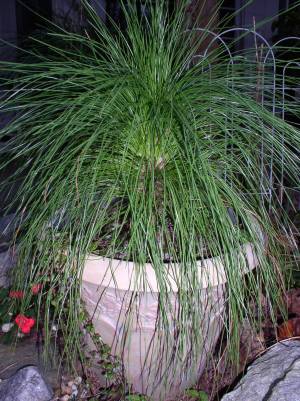
Dec. 20 - Long-leaf Pine: Pinus palustris
Although a tree, makes for a great container
plant while in its grass phase.
Dec. 27 - Shamrock Inkberry: Ilex glabra
'Shamrock'
To top of page
January 2004
Jan 3: Norfolk Island Pine: Araucaria heterophylla - Native to Norfolk Island near Australia.
This house plant which isn't a pine,
is often used as a living indoor Christmas
Tree. It is a frost-tender houseplant
that can be placed outside for the summer,
but must be brought indoors for the winter.
Jan 10: American Holly: Ilex opaca - a native tree form holly reaching 30-60
feet or more in height.
Jan 17: Northern Sea Oats: Chasmanthium latifolium - a clumping ornamental grass reaching 3-4
feet in height with seed clusters resembling
oats. Very shade tolerant. Warning:
this plant reproduces prolifically from seed,
but it is native, so give it a place to spread.
Can be used for erosion control.
Jan 24: American Devilwood: Osmanthus americanus - the most cold hardy (zone 5/6) in the osmanthus
genus and it's native!
May have to search around to find it - Green
Plant Market near P'tree City
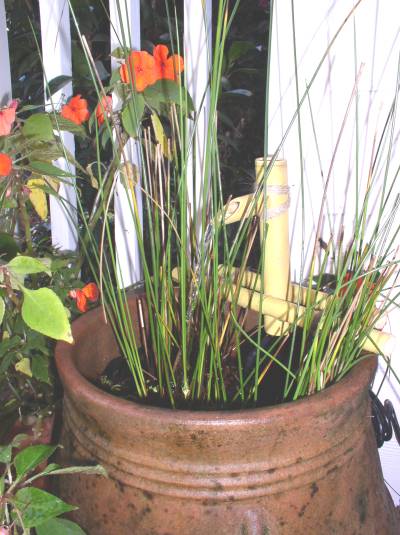
Jan 31: Common Rush: Juncus effusus - a native evergreen "spiky" plant
growing 24-48 inches tall. Good for
the edge of wet to moist areas or as a container
plant. Can handle sun or shade. Great for
erosion control. Photo below shows common
rush in a small container fountain.
To top of page
February 2004
February 7: Red-Osier Dogwood (aka Red Twig
Dogwood): Cornus sericea
(aka C. stolonifera) - This native dogwood
is a suckering shrub not a
tree and is commonly found on moist to wet
soils from Georgia northward
to Canada. It has great winter interest as
the stems can be a shocking
red color, although yellow cultivars exist.
Flowers are in clusters and
bloom later than our tree dogwood.
Winter Image
More Information
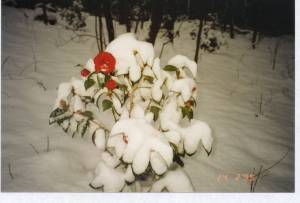
February 14: The 'Glen 40' Camellia: Camellia
japonica 'Glen 40' - On
Valentine's Day red roses are traditionally
given as a gift. However,
if you want a beautiful red flower blooming
in the garden, this is your
plant. Attached is a picture of my Glen 40
camellia in bloom with snow
on it!
Info & Image
American Camellia Society web site
February 21: Carolina and Swamp Jessamine:
Gelsemium sempervirens and G.
rankinii - Native, evergreen vines that produce
scores of yellow flowers
in the early spring (February to April) and
then again sporadically in
the late summer.
February 28: Alleghany (Spurge) Pachysandra
: Pachysandra procumbens -
Native, evergreen cousin to the Japanese
Pachysandra. Alleghany
Pachysandra has larger leaves mottled with
gray and white and larger
flowers. Much prettier and resistant to insects
and diseases that
plague its Japanese counterpart.
Information
Image
To top of page